ADHD Paralysis: How to Get Unstuck in 5 Minutes
A five-minute script for ADHD paralysis, the moment you know what to do but cannot start. What to do minute by minute, and what to try if five minutes is not enough.
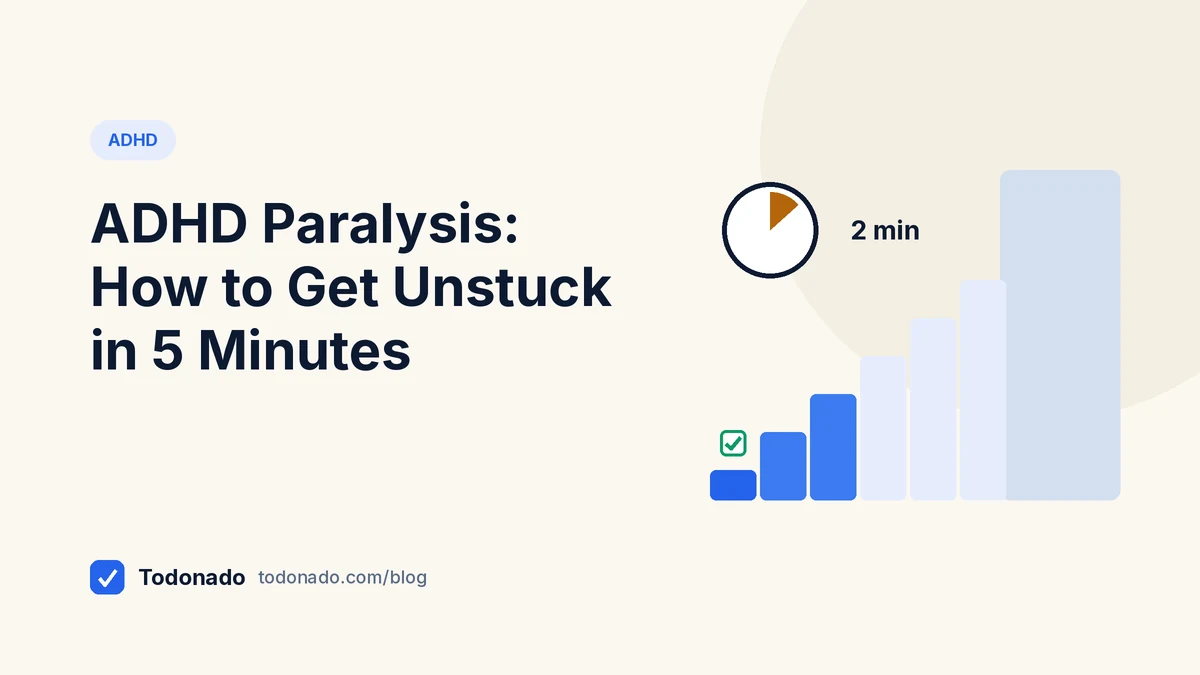
When ADHD paralysis hits, stop trying to start the whole task. For the next five minutes, do this: stand up and move for one minute, write down the single first physical action, set a two-minute timer, and do only that action until it rings. Then decide whether to keep going. The aim is to get unstuck fast, not to feel ready. Most of the time, the hard part was the start, and the start is now behind you. If it is not, the second half of this guide covers what to try next.
Our main guide to ADHD task paralysis explains what the freeze is, why it happens and how to set up your days so it happens less. This one is shorter and narrower. It is for the moment itself, when you are staring at the screen and need something to do right now.
What ADHD paralysis feels like
People describe it in similar ways. You know the task. You may even want to do it. But you sit there, scroll, open and close tabs, and the time goes. It can feel like a wall between you and the first step. Often it is worse when there are many tasks and you cannot choose, or when one task feels big and vague.
Overcoming task paralysis starts with knowing it for what it is. This is not laziness. It is a common experience for people with ADHD and is linked to the way attention and starting work for them. It also happens to people without ADHD, especially under stress.
The five-minute script
| Minute | Step | Why it helps |
|---|---|---|
| 0 to 1 | Stand up and move: walk to the kitchen, stretch, drink water | Breaks the loop of sitting and scrolling |
| 1 to 2 | Write the first physical action on paper | Turns a vague task into something your hands can do |
| 2 to 3 | Remove one blocker: close tabs, put the phone in another room | Makes the start smaller |
| 3 to 5 | Set a two-minute timer and do only the first action | Starting is the goal, not finishing |
| At 5 | Choose: keep going, take a break, or try the next step below | You decide, instead of drifting |
Minute 1: move
Do not stay in the chair. A short walk or a glass of water changes your state. You are not wasting time. You are breaking the loop.
Minute 2: write the first action
Not "do the report". Write "open the report file and read the last paragraph". The action should be so small that it feels almost silly. That is the point.
Minute 3: remove one blocker
Pick the one thing most likely to pull you away. Usually it is the phone. Put it in another room or face down out of reach.
Minutes 4 and 5: two minutes of the action
Set a timer for two minutes. Do only the first action. When the timer rings, stopping counts as success. You have started, and that was the goal.
A worked example
Nadia has an email to her landlord about a repair. It has been on her list for a week. At 2pm she sits down to write it and freezes for 20 minutes.
She runs the script:
- Minute 1. She walks to the kitchen and fills a glass of water.
- Minute 2. She writes on a sticky note: "Open a new email and type Hi Mark."
- Minute 3. She puts her phone on the kitchen counter.
- Minutes 4 and 5. She sets two minutes and types "Hi Mark, the kitchen tap has been dripping since..."
When the timer rings, she has two sentences. She keeps going. The email is sent at 2:12. The task took seven minutes. The freeze before it took twenty.
How to get out of ADHD paralysis when five minutes is not enough
Sometimes the script does not work. That is information. The kind of stuck tells you what to try next.
| You feel... | Likely cause | Try this |
|---|---|---|
| "There is too much, I cannot choose" | Too many options | Pick the task with the nearest deadline, or the smallest one, and hide the rest |
| "I do not know where to start" | Task too vague | Break it down further. Our guide to how to break down tasks helps |
| "I know what to do, I just cannot" | Low activation | Find a body double: someone in the room or on a call. See body doubling |
| "I am scared it will go badly" | Fear of the outcome | Do a deliberately rough version first, marked "draft" |
| "I have no energy at all" | Exhaustion | Rest first. Pick one tiny task, or none, for today |
None of these are failures. They are different problems with different fixes.
How Todonado can make the start smaller
Todonado will not unfreeze you, and no app can promise that. What it can do is make the next step smaller and more visible. Tasks can hold subtasks, so "write the report" can have "open the file and read the last paragraph" as its first step, right where you will see it. Start a focus session on that one subtask and the timer gives the start a clear, short shape.
The Today view shows only today's tasks, with the rest of your list out of sight, which helps when the freeze comes from too many choices. "Plan my day" can fill today from your list without going over the capacity you set, so you are not choosing from forty items in the moment.
Why such small steps work
The script can look too simple. Walk to the kitchen, write one line, type two sentences. But each step is chosen to remove a specific barrier.
Moving breaks the loop you are in. When you have been staring at the screen for 20 minutes, the screen itself has become part of the freeze. A change of position is a small reset.
Writing the action on paper moves the plan out of your head. Holding a vague task in mind takes effort, and that effort is part of what feels heavy. A written action is just an instruction to follow.
The two-minute timer lowers the stakes. Nobody is afraid of two minutes. And once you have started, the task is no longer an unknown. It is something you are already doing, which is usually easier to continue than to begin.
Finally, the choice at minute five matters. You are not forcing yourself to keep going. You are allowed to stop. Knowing that makes the start feel safer, and most people keep going anyway.
Setting up for fewer freezes
The script is for the moment. A few habits make the moment less frequent:
- Plan the first action the night before. Write it on a sticky note on your keyboard.
- Keep today's list short. Three to five items. Everything else lives elsewhere.
- Start hard tasks at your best time of day. For many people, that is the morning.
- Use a visual timer. Seeing time pass can make a short start feel safe. Our guide to ADHD time blindness strategies covers timers.
About ADHD paralysis treatment
This script is a coping tool, not a treatment. ADHD is diagnosed and treated by health professionals, and treatment can include medication, therapy and coaching. The NHS page on ADHD is a good starting point for understanding options. If freezes are frequent and affect your work, study or home life, it is worth talking to a doctor.
FAQ
How long does ADHD paralysis last? It varies. It can be minutes or days for the same task. A short script like this aims to shorten the minutes.
Is ADHD paralysis the same as procrastination? They overlap. Procrastination often involves putting off a task you dislike. Paralysis often happens even with tasks you want to do. Our guide on how to stop procrastinating covers the mood side.
What if the freeze happens every day? Look at the setup, not just the moment. Keep the list short, plan first actions in advance, and consider talking to a professional.