How to Break Down Tasks Into Steps You Will Actually Start
How to break down tasks that feel too big to start. Shrink each one to a first physical action, size the steps in minutes, and stop at the right level.
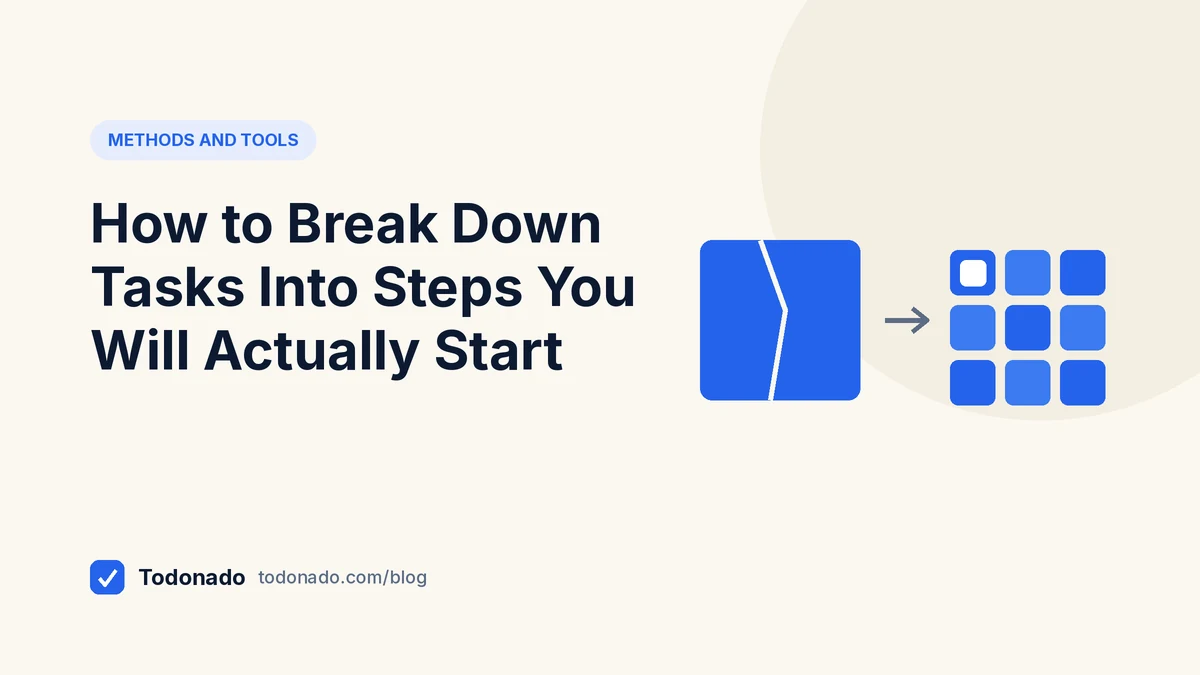
To break down a task, ask one question: what is the first physical thing I would do? Write that down as the task. Then ask the same question again for the next step, and keep going until each step would take 15 to 60 minutes and has an obvious place to start. Stop there. Do not plan every step in advance. You only need the next two or three to be clear.
Most tasks that sit on a list for weeks are not too hard. They are too vague. "Sort out the website" has no first move. "Open last month's analytics and note the three slowest pages" does.
Why big tasks get stuck
A task like "plan the team offsite" is really a project with a dozen decisions inside it. When you look at it, your brain cannot see where to begin, so it moves on to something clearer, like email. This is not laziness. It is a reasonable response to a task with no handle.
Breaking a task down gives it a handle. Each step is small enough that starting costs almost nothing, and finishing it gives you a small win and a clear view of the next step.
There is also a planning reason. You cannot estimate "plan the offsite". You can estimate "email three venues for prices and dates", which is about 20 minutes. Only estimated steps can be fitted into a real day.
How to break down tasks in five steps
- Write the outcome. What does done look like? "Offsite booked, agenda sent" is clearer than "offsite".
- Find the first physical action. Imagine starting right now. What do your hands do? Open a file, write an email, make a call, find a document. That is step one.
- List the next two or three steps. Only as far as you can see clearly. Later steps depend on what you learn early.
- Size each step. Put a rough estimate on each: 15, 30, 60 or 90 minutes. If a step is over 90 minutes, break that step down again.
- Mark decisions as tasks. "Decide the budget" is a real step. Many tasks stall because a decision is hidden inside them.
The "small enough" test
A step is small enough when you can answer yes to all four:
| Question | Why it matters |
|---|---|
| Do I know the very first action? | Without it, you will hesitate |
| Can it be done in one sitting? | Steps that span days are projects |
| Do I have what I need to start? | Missing info is a separate step: "ask for it" |
| Would I know when it is done? | Vague steps never feel finished |
If any answer is no, the step needs one more split. If all four are yes, stop splitting. Going further, into five-minute micro-steps, usually wastes time unless you are really stuck.
A task breakdown example at work
Here is an example from a normal office job. The task "write the quarterly report" has sat on a list for two weeks. Here it is broken down:
| Step | First action | Estimate |
|---|---|---|
| Gather the numbers | Open the sales dashboard, export Q3 | 30 min |
| Ask finance for costs | Email Lee with the three figures needed | 10 min |
| Outline | Write five headings in a blank doc | 20 min |
| Draft the summary | Write the first paragraph only | 45 min |
| Draft the sections | One heading at a time | 90 min |
| Review and send | Read once, fix, send to manager | 30 min |
The total is about 3 hours 45 minutes. That is useful on its own: it tells you this is not a task for a busy afternoon, but two or three sessions across the week.
Notice step two. It is ten minutes, and it unblocks everything after it, because finance needs time to reply. Steps that involve other people should go first, even if they are small.
A breakdown example at home
"Sort out the spare room" is a classic stuck task. Broken down:
- Take everything off the bed and the floor and put it in three piles: keep, donate, bin. (60 min)
- Bag the donate pile and put it in the car. (15 min)
- Take the bin pile out. (10 min)
- Find a home for each keep item, starting with the largest. (60 min)
- Vacuum. (15 min)
Two hours and forty minutes, across two weekend sessions. More importantly, step one is now clear and starting feels possible.
How to break down tasks with ADHD
The same method works, with three changes that many people find helpful.
- Make the first step tiny. If starting is the hardest part, the first step can be two minutes: "open the document". Momentum often carries you into the next step.
- Write steps where you will see them. A breakdown in your head is gone by lunch. Put the steps on the list itself, as subtasks if your tool allows it.
- Add the time guess, then add a margin. Estimates tend to run low, especially for unfamiliar work.
If starting is the main problem rather than knowing where to start, our guide to ADHD task paralysis goes deeper. And how to stop procrastinating covers the mood side of avoidance.
Where Todonado helps
Todonado supports this kind of breakdown directly. Tasks can have subtasks, so "write the quarterly report" can hold its six steps underneath it. Each task carries an effort estimate in minutes, and the Today view totals the estimates against the capacity you set, so you can see whether today has room for the 90-minute drafting session or only the 10-minute email.
Templates help with tasks you repeat. If you write a report every quarter, save the breakdown as a personal template and reuse it. Todonado does not break tasks down for you automatically. The thinking above is still yours, and it is worth doing by hand.
When breaking down does not help
Breaking down is a fix for vagueness. It does not fix everything.
- If you do not want to do the task, smaller steps will not change that. Ask whether it should be done at all, delegated, or dropped.
- If the task is blocked, the only step is the unblocking one: "ask Sam for the login". Write that and nothing else.
- If you are breaking down to avoid starting, stop. A plan with 40 tiny steps can be its own form of procrastination. Two or three clear steps are enough to begin.
FAQ
How small should a task be? Small enough to start without thinking and finish in one sitting. For most work that means 15 to 60 minutes.
Should I break down a big project all at once? No. Break down the first few steps clearly and leave the rest as rough milestones. You will know more once you start.
What if my estimate is wrong? It probably will be. Estimates are for fitting work into a day, not for accuracy. Our guide to planning a realistic day explains how to plan around estimates that run low.