ADHD Weekly Planner: How to Plan a Week That Survives Bad Days
An ADHD weekly planner method that plans for your worst days, not your best. A 20-minute routine, a copyable template and a worked example week.
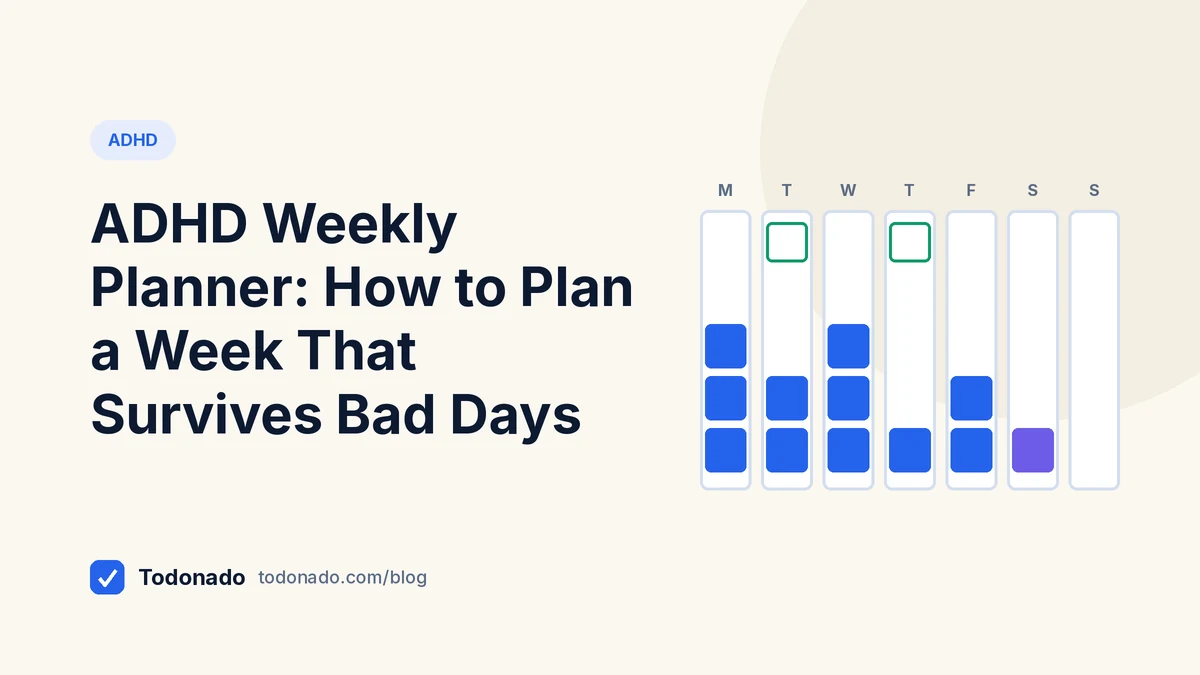
An ADHD weekly planner works best when you plan for your worst days, not your best. Each week, take 20 minutes. Pick three things that matter, put them early in the week, and fill each day to only about half of what you think it can hold. Leave one or two slots in the week completely empty, as buffer. When a day goes badly, the work moves into the buffer instead of falling apart.
This is not a medical guide, and planning is not a treatment for ADHD. It is a practical method that many people with ADHD, and many without it, find easier to keep than a full, colour-coded week.
Why normal weekly planning breaks
Most weekly planning advice assumes a steady week. Plan Monday to Friday, fill the slots, follow the plan. For many people with ADHD, energy and focus vary a lot from day to day. A plan built for a good day fails on a bad one, and once Tuesday falls apart, the rest of the week often goes with it.
There are a few common patterns.
- Overplanning on Sunday. Planning feels good, so the week gets packed. By Wednesday it is clearly impossible.
- Time blindness. Tasks take longer than expected, and the week runs out of hours. Our guide to ADHD time blindness strategies covers this in depth.
- All-or-nothing. One missed task makes the whole plan feel broken, so it gets abandoned.
- Out of sight, out of mind. A weekly plan written in a notebook that stays closed does not exist on Thursday.
A good ADHD weekly planning method expects all four.
The 20-minute weekly routine
| Minutes | Step | What to do |
|---|---|---|
| 0 to 5 | Empty | Brain dump anything on your mind for the week |
| 5 to 8 | Pick three | Choose three things that would make the week a good one |
| 8 to 12 | Fixed points | Write down appointments, deadlines and meetings |
| 12 to 17 | Place | Put the three things on early days, with a time estimate |
| 17 to 20 | Buffer | Mark one or two empty slots, and stop |
Pick three, not ten
Three is a limit, not a target. If you only manage two, the week still worked. Pick things that matter, not things that are loud. "Send the invoice" might be small but important. "Clean the inbox" is loud but can wait.
Place them early
Put the important things on Monday, Tuesday or Wednesday. If a day goes badly, there is still time to recover later in the week. Work planned for Friday has no second chance.
Fill each day to about half
If you think a day can hold six hours of tasks, plan three. This feels wasteful. It is not. The other hours will fill with things you did not plan, such as messages, errands, a task that ran over, or a day when focus never arrived.
Buffer days and slots
Leave at least one half-day empty. Many people use Thursday afternoon or Friday. When something slips, it goes there. If nothing slips, you get free time or a head start on next week. Buffer days are what make the plan survive a bad day.
ADHD weekly planner template
Copy this ADHD weekly planner template onto paper or into a note. A single page is enough.
WEEK OF: __________

THREE THINGS THAT MATTER
1. ________________  (est: ___)  day: ___
2. ________________  (est: ___)  day: ___
3. ________________  (est: ___)  day: ___

FIXED POINTS (appointments, deadlines)
Mon ______  Tue ______  Wed ______  Thu ______  Fri ______

DAILY PLAN (half-full on purpose)
Mon: ____________________
Tue: ____________________
Wed: ____________________
Thu: BUFFER (afternoon)
Fri: ____________________

ONE EASY WIN EACH DAY: ________________
If you prefer a printable ADHD weekly planner, paste this into a document and print it. Put it somewhere you will see it every day, like the fridge or next to your laptop. A plan you cannot see does not help.
A worked example week
Sam works in customer support and has ADHD. On Sunday evening, Sam spends 20 minutes on the routine above.
Three things: finish the training slides (3 hours), book the car service (15 minutes), reply to the landlord about the lease (20 minutes).
Placed: car service on Monday morning, landlord reply on Monday afternoon, slides split into two 90-minute blocks on Tuesday and Wednesday.
Buffer: Thursday afternoon.
Here is how the week went.
| Day | Planned | What happened |
|---|---|---|
| Monday | Car service, landlord reply | Both done |
| Tuesday | Slides, part 1 (90 min) | Started late, did 45 minutes |
| Wednesday | Slides, part 2 (90 min) | Low-energy day, did nothing on the slides |
| Thursday | Buffer | Finished slides in a 2-hour session |
| Friday | Light admin | Done, plus an early finish |
Two of the three things were done on Monday. The slides ran late and Wednesday went badly. In a full plan, that would have meant a crisis on Friday. With a buffer, the slides were done on Thursday.
How to keep the plan visible
- One place. Use one planner or one app, not three.
- Look at it each morning. Two minutes, to pick today's tasks from the week.
- Use reminders for fixed points. Appointments and deadlines should alert you, not rely on memory.
- Plan with someone. Some people find it easier to plan in a short call with a friend or partner. This is a form of body doubling.
Using Todonado for the week
Todonado's Pro plan includes a week view with seven days side by side, each with its own capacity meter. You can set a lower capacity on purpose, such as three hours instead of six, and the meter will warn you before a day is overbooked. Tasks you do not finish roll forward instead of vanishing. "Plan my week" can spread tasks across the days without going over the capacity you set.
On the Free plan, the same capacity meter and overbooking warning work for each day, and "Plan my day" fills today without going over. Free is enough to plan one day at a time with a limit. The week view is a Pro feature, at $5 a month or $48 a year.
What to do when the week falls apart
It will sometimes. That is not a failure of you or the plan.
- Do not start over. Look at what is left of the three things.
- Move them, do not delete them. Put them into the buffer or next week.
- Pick one thing for today. Just one, and make it small.
- Review on Friday. Note what got in the way, without blame. A short weekly review helps you plan better next time.
If the week falls apart because you cannot start tasks at all, our guide to ADHD task paralysis may help.
FAQ
Is a weekly or daily planner better for ADHD? Many people use both: a weekly plan for the three big things and a short daily list. The weekly view stops the daily list from forgetting what matters.
How do I plan my week with ADHD if my schedule changes a lot? Plan less, not more. Keep the three things and the fixed points, and decide the rest each morning.
What if I forget to plan? Set a recurring reminder for the same time each week, and keep the routine to 20 minutes so it never feels like a big job.