ADHD Morning Routine: Fewer Steps, Fewer Late Starts
An ADHD morning routine with fewer steps, a night-before checklist and timers for transitions. A 45-minute template, a 15-minute bad-day version and tips.
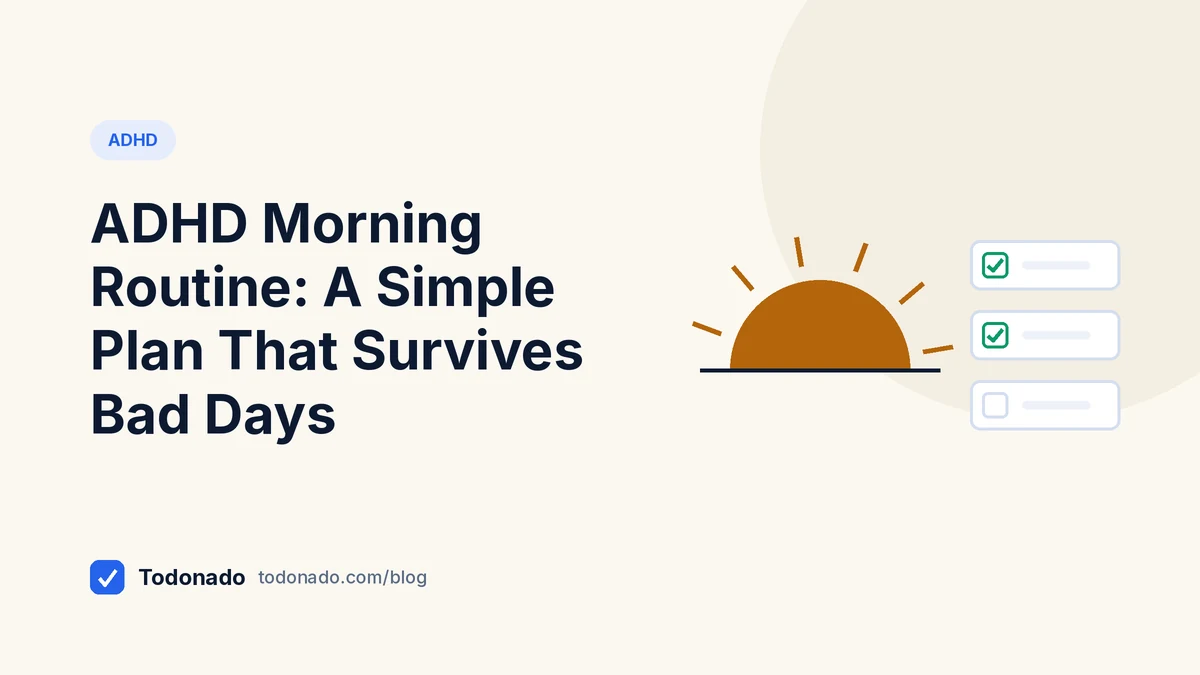
A good ADHD morning routine has fewer steps than you think, moves every decision to the night before, and uses timers for the moments where time slips. Start with four to six steps in a fixed order, put the list where you will see it, such as on the bathroom mirror, and set out clothes, bag and keys the evening before. Then make a short bad-day version with the same order, so a rough morning still follows the routine instead of falling apart.
This is practical advice for adults with ADHD, or anyone whose mornings tend to unravel. It is not medical advice.
Why mornings are hard with ADHD
Mornings ask a lot of executive function, the set of skills for planning, starting and switching tasks. You have to wake up, make a string of small decisions, keep track of time and leave by a fixed moment. The CHADD page on executive function describes these skills and how ADHD can affect them.
Three things tend to go wrong:
- Decisions. What to wear, what to eat, what to bring. Each one is small, but they add up.
- Time. A shower that "takes five minutes" takes fifteen. Our guide to ADHD time blindness strategies covers why.
- Getting lost in something. One look at your phone, and twenty minutes are gone.
A good routine works on all three.
The night-before checklist
Most of a good morning happens the evening before. Spend ten minutes after dinner on this:
NIGHT BEFORE (10 minutes)
[ ] Clothes out, including shoes
[ ] Bag packed: keys, wallet, badge, charger
[ ] Breakfast decided (and set out if possible)
[ ] Tomorrow's first task written on a sticky note
[ ] Phone charging outside the bedroom
[ ] Alarm set
Put the bag by the door, on top of the shoes if you can. If you have to step over it to leave, you will not forget it.
A 45-minute ADHD morning routine template
| Time | Step | Tip |
|---|---|---|
| 0 to 5 min | Get up, drink water, light on | Water and light by the bed |
| 5 to 20 min | Shower and dress | Visual timer set to 15 minutes |
| 20 to 30 min | Breakfast | No phone at the table |
| 30 to 35 min | Teeth, meds if you take them | Keep them in one spot |
| 35 to 40 min | Look at today's first task | The sticky note from last night |
| 40 to 45 min | Shoes on, bag, out | Timer for "shoes on" time |
Keep the steps in the same order every day. The order is what makes it a routine, because you stop having to think about what comes next.
Put the list where you will see it
Write the steps on a card and tape it to the mirror or the inside of the front door. You do not need to remember the routine. You need to see it.
Use timers for transitions
Set a timer for the slow steps, usually the shower and breakfast. A visual timer, one that shows time as a shrinking disc, is easier to read at a glance than a clock. Our guide to visual timers for ADHD covers the types.
Why the order matters more than the time
It is tempting to build a routine around a clock: up at 6:30, shower at 6:35, breakfast at 6:50. That works until you wake at 6:45. Then every step is late, and the routine feels broken before it starts.
A routine built on order is sturdier. Each step is the cue for the next. Water, then shower, then dress, then breakfast. If you wake late, the order stays the same and only the length of each step changes. You are still doing the routine, just faster.
Order also cuts down on decisions. When you know that breakfast always comes after dressing, you do not have to decide what to do next. On a foggy morning, that is one less thing to think about. Over a few weeks, the steps start to run on their own, which is the whole point of a routine.
The 15-minute bad-day version
Some mornings you oversleep or wake up foggy. On those days, do not skip the routine. Shrink it.
| Time | Step |
|---|---|
| 0 to 2 min | Water and light |
| 2 to 8 min | Dress (clothes are already out) |
| 8 to 11 min | Teeth, meds |
| 11 to 13 min | Grab breakfast to eat later |
| 13 to 15 min | Shoes, bag, out |
The bad-day version keeps the same order. That matters. It means a bad morning is still a version of your routine, not the end of it.
A worked example
Elena works in an office and was leaving late about three times a week. Her mornings had no fixed order, and she often lost time on her phone in bed.
She made three changes:
- Phone charging in the kitchen, with a cheap alarm clock by the bed.
- A night-before checklist taped inside the wardrobe door.
- A visual timer in the bathroom set to 15 minutes.
| Week | Late days | Notes |
|---|---|---|
| Before | 3 of 5 | Phone in bed, no fixed order |
| Week 1 | 2 of 5 | Forgot the night-before list twice |
| Week 2 | 1 of 5 | Used the bad-day version once |
| Week 3 | 0 of 5 | Checklist became a habit |
This is one person's log, not a study. But each change is easy to test on yourself.
Using Todonado for your morning
Todonado's template catalog includes a Morning Routine checklist you can change to fit your steps. Add it as a repeating task with subtasks for each step, and give it a time estimate so it counts toward your day. The daily briefing shows what is on today, which can replace the sticky note for your first task if you prefer a screen.
If you start work right after the routine, the focus timer can run your first work block, so the shift from morning to work has a clear start.
ADHD routine tips that help
These tips come up again and again when people with ADHD describe what made their mornings work.
- Start with fewer steps. Four steps you do beat ten you skip.
- Make it visible. Lists on mirrors and doors, not in your head.
- Remove the phone. Charge it outside the bedroom if you can.
- Expect bad days. That is what the short version is for.
- Change one thing at a time. Add a new step only when the old ones feel automatic.
When a routine is not enough
A routine helps, but it cannot fix poor sleep, and it cannot replace treatment. If mornings are a struggle every day despite a good routine, sleep or other health factors may be part of the picture, and it is worth talking to a doctor. Our guide to an ADHD to-do list covers the rest of the day.
FAQ
How long should an ADHD morning routine be? As short as possible while still covering the basics. Many people use 30 to 45 minutes, with a 15-minute backup.
Should I exercise in the morning? If you can, some people find it helps them focus. If it makes the routine too long, move it to later.
What if I keep forgetting the night-before list? Stack it on something you already do, like starting the dishwasher.