Parkinson’s Law: Why Work Fills the Time You Give It
Parkinson's law says work expands to fill the time available. What it means, where it came from, and five ways to use it with shorter deadlines and time limits.
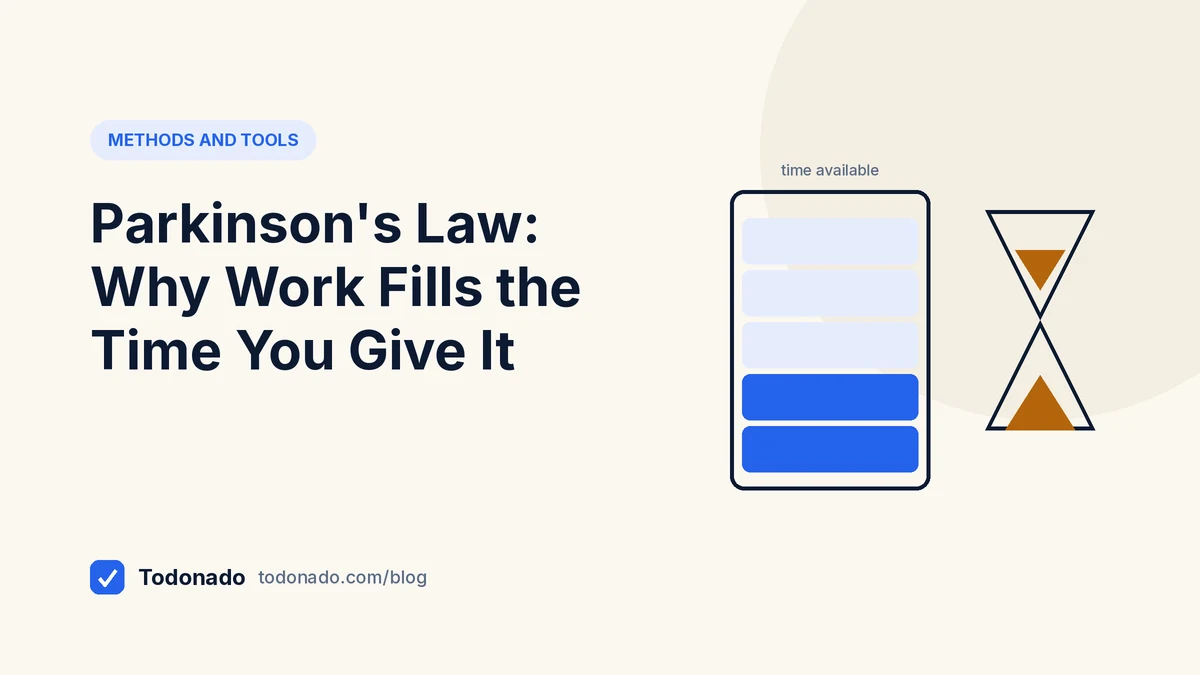
Parkinson's law is the idea that "work expands so as to fill the time available for its completion." In plain terms, if you give a task a week, it tends to take a week, and if you give it two hours, it often fits in two hours. To use it, give each task a time limit that is shorter than the open time you have, but realistic, and write that limit next to the task. Then stop when the time is up and decide whether more time is really worth it.
Where Parkinson's law comes from
The phrase comes from Cyril Northcote Parkinson, a British historian, who opened a humorous essay in The Economist in 1955 with that line. According to the Wikipedia article on Parkinson's law, the essay was mainly about how government offices grow over time, whatever the amount of work. The sentence about work filling time became the part people remember.
So it was not a scientific finding. It was an observation, made partly as a joke. But it matches what many people notice in their own work, which is why it has lasted.
Parkinson's law meaning in everyday work
The idea shows up in a few familiar ways:
- The deadline effect. A report due Friday gets most of its work on Thursday.
- Polishing. With extra time, you keep tweaking slides that were fine an hour ago.
- Meetings. A one-hour meeting slot is often filled, even when the topic needed twenty minutes.
- Small tasks. Replying to email can take the whole morning if the morning is open.
None of this means you are lazy. Open time invites more research, more checking and more small decisions. That is the real meaning of the law for most people: time without an edge gets used up by things that do not need doing.
These examples have something in common. In each case, nobody set a limit, so the only limit was the deadline or the end of the slot. The fix is to set a limit yourself.
Five ways to use Parkinson's law
1. Give every task a time limit
Decide how long a task should take before you start, and write it next to the task. "Draft the proposal: 90 minutes." The limit becomes the target.
2. Set artificial deadlines
Artificial deadlines are dates you choose yourself, ahead of the real ones. If the real deadline is Friday, set your own for Wednesday. Tell someone, or put it in the calendar, so it feels real. Keep the real deadline as your buffer.
3. Shrink meetings
Book 25 or 50 minutes instead of 30 or 60. Many calendar apps can do this by default. The meeting usually still covers what it needs to.
4. Batch small tasks into a fixed slot
Give email and admin a fixed slot, such as 30 minutes twice a day, instead of letting them fill the gaps. Our guide to task batching shows how.
5. Stop at the limit and decide
When the time is up, stop and ask: is more time worth it? Sometimes it is. Often, the work is good enough, and the extra hour would only polish it.
A time limit for tasks: starting points
| Task | Open-ended habit | Try this limit |
|---|---|---|
| Email inbox | All morning | 30 min, twice a day |
| First draft of a document | Days | 90 min |
| Slide deck for an internal meeting | An afternoon | 60 min |
| Weekly planning | Never quite done | 20 min |
| Research before a decision | Open | 45 min, then decide |
These are starting points, not rules. Change them after you see how long things really take.
Parkinson's law examples: a worked case
Lina has a client proposal due in two weeks. The first time, she leaves it open. She reads around the topic for days, starts three drafts, and does most of the work in the last two days. Total time: about 11 hours, spread over two weeks.
The next time, she gives the same kind of proposal a plan:
| Step | Limit | Actual |
|---|---|---|
| Research | 45 min | 50 min |
| Outline | 20 min | 20 min |
| First draft | 90 min | 100 min |
| Edit | 45 min | 40 min |
| Total | 3 hours 20 min | 3 hours 30 min |
She went over the limit a little, and the proposal was just as good. This is one example, not a study, but it shows the shape of the effect.
Why this works on the brain as well as the clock
A time limit does two things. First, it gives you a clear target, so you know when you are done. Second, it makes you choose. With 90 minutes for a draft, you cannot read every source, so you pick the three that matter most. That choice is often where the time savings come from.
The limit also helps with starting. A task with no end can feel too big to begin. A task that ends in 45 minutes feels manageable, even if it is a task you have been avoiding.
Using Todonado to set time limits
Todonado asks for an effort estimate on each task, with presets of 15, 30, 60, 90 and 120 minutes. That estimate is your time limit. The capacity meter adds the day's estimates and shows how full the day is, so you can see when the limits add up to more than you have. Start a focus session on a task and the timer counts down the time you gave it.
On Pro, Insights compare the time you planned with the time you actually spent. Over a few weeks, that shows which tasks you underestimate and which you give too much room.
The limits of Parkinson's law
There is a downside. A limit that is too short turns into stress, rushed work and mistakes. People also tend to underestimate how long tasks take, a pattern called the planning fallacy. In a 1994 study, Buehler, Griffin and Ross found that students finished their projects later than they predicted, even when they remembered that past projects had run late.
So a time limit works best when it is short but honest. If you keep going over, raise the limit. The goal is to stop work from spreading, not to squeeze it until it breaks. Our guide on how to plan a realistic day covers how to set honest estimates, and time blocking vs time boxing explains timeboxing, a method built on this idea.
FAQ
Is Parkinson's law real? It is an observation, not a scientific law. Many people find it true of their own work.
Who came up with it? Cyril Northcote Parkinson, in an essay in The Economist in 1955.
How is it different from timeboxing? Timeboxing is a method that uses the idea. You give a task a fixed box of time and stop when it ends.