How to Focus When Working From Home When Everything Pulls at You
Home is full of tasks that are not work, and work that never ends. Practical ways to set up space, time and signals so you can focus at home, with fixes for the most common traps.
Give your brain the signals an office used to give it: a fixed start time, a set place to work, a clear finish. Then remove the home's pull during focus time by keeping chores and the phone out of reach. That is the core of how to focus when working from home. Most of it is environment, not willpower.
Why focus is harder at home
In an office, many things told you it was work time: the commute, the desk, the people around you. At home, those cues are gone, and new ones compete. Home distractions are everywhere. The laundry is right there. The fridge is right there. The bed is ten steps away.
Home also blurs the end of the day. Without a commute, work can leak into the evening, and tired evenings lead to unfocused mornings.
Five home focus traps and their fixes
| Trap | What it looks like | Fix |
|---|---|---|
| Chore drift | "I'll just put a load on" turns into 40 minutes | Chores only in breaks, on a list |
| The sofa office | Working from bed or sofa, half-asleep by 11:00 | One work spot, even a corner |
| No start | Checking email in pyjamas at 7:30, real work at 10:00 | A fixed start ritual |
| Phone scroll | Phone on the desk, "quick look" every ten minutes | Phone in another room during focus |
| Endless day | Laptop open until 21:00 | A shutdown routine at a set time |
Set up a work spot
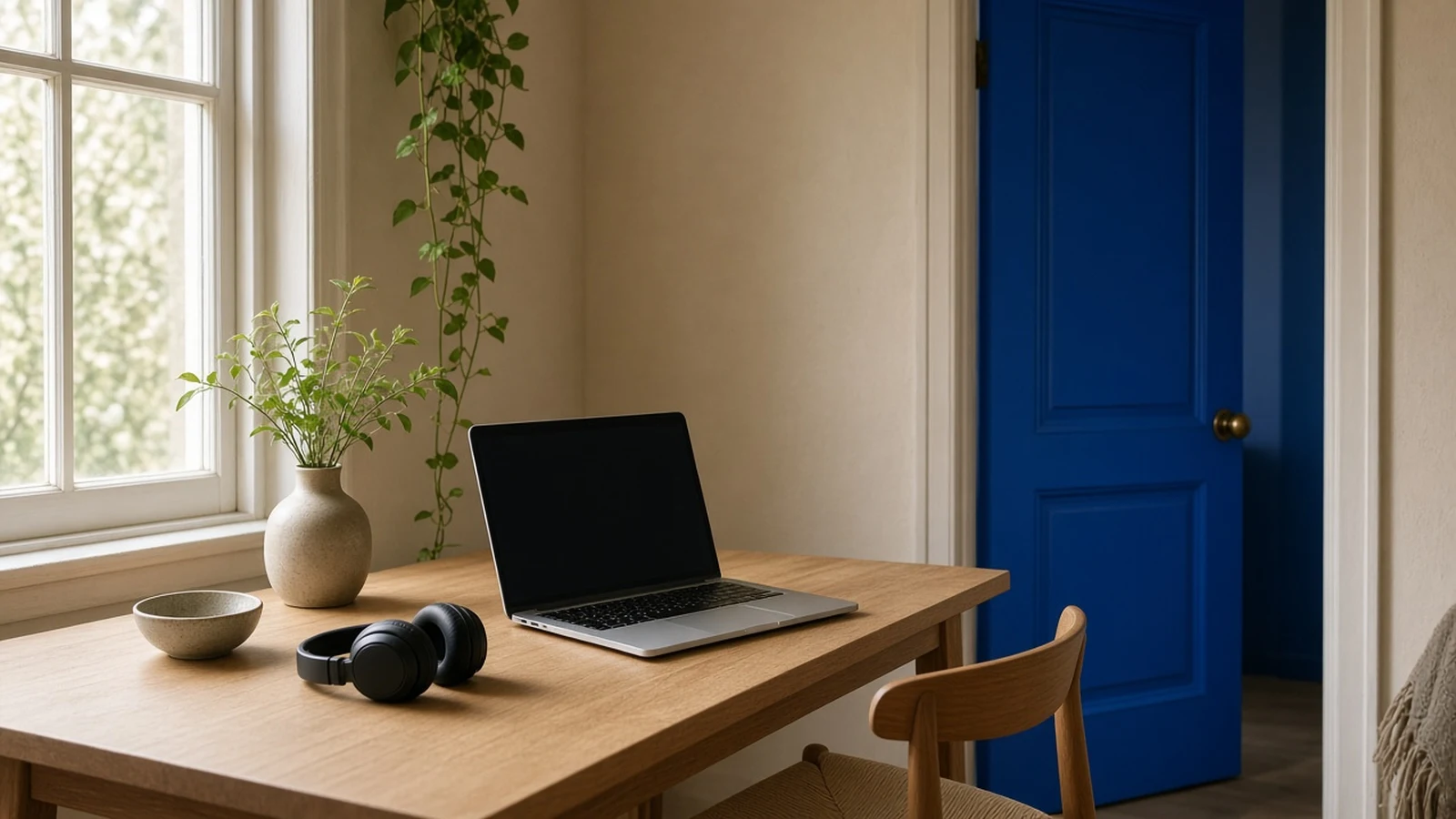
You do not need a home office. You need a place that means work. A corner of the kitchen table works, if that corner is where you work and nowhere else. Keep your work things there and, if possible, put them away at the end of the day.
Face away from the mess if you can. Seeing a pile of dishes or laundry keeps pulling at your attention.
Create a start ritual
Replace the commute with something short and consistent:
- Get dressed for the day, even if casually
- Make a coffee and take it to the work spot
- Read your plan for today before opening email
Some people take a ten-minute walk before starting, a "fake commute". It sounds odd. It helps a lot of people mark the switch.
Protect focus blocks
Plan one or two focus blocks a day, like you would in the office, and protect them harder at home. Close chat and email. Put the phone in another room. A deep work schedule can help you decide when and how long.
If people at home interrupt you, agree on a signal. Headphones on means "only if urgent". A closed door means the same. This works better than explaining every time. There are more tips for this in our guide to handling interruptions at work.

Use chores as breaks, on purpose
Home chores are not the enemy. They make great breaks, if you control them. Keep a short list of five-minute chores: empty the dishwasher, hang the washing, water the plants. Do one between focus blocks. You get movement, a real break, and a tidier house, without the drift.
The rule is simple: chores happen in breaks, not instead of work.
A worked example day
Here is a full remote day for someone with a 9:00 to 17:30 job.
- 8:30: walk around the block, coffee, read today's plan
- 9:00 to 10:30: focus block, phone in the bedroom
- 10:30 to 10:45: break: hang the washing
- 10:45 to 12:00: email, calls, messages
- 12:00 to 12:45: lunch away from the desk
- 12:45 to 14:30: meetings
- 14:30 to 16:00: second focus block
- 16:00 to 17:15: smaller tasks, replies
- 17:15 to 17:30: shutdown, close the laptop, put it away
Each part of the day has a clear signal. That is the point.
End the day for real
The most common complaint about remote work is that it never ends. A short workday shutdown ritual closes the loop: capture open tasks, choose tomorrow's first step, close the laptop. Put it out of sight if you can.
The limitations
Some homes make this very hard: small spaces, young children, shared rooms. If you truly cannot get quiet, look at a library or café for your focus block, or a coworking day once a week. And if focus problems follow you everywhere, home or office, the issue may not be the setting. Our guide on how to stop procrastinating may be a better start.
Questions about working from home
Is it better to work in the bedroom or the living room?
If you can, avoid the bedroom. Working where you sleep can blur the line between rest and work in both directions. If the bedroom is the only quiet room, set up a clear work corner and put work things away at the end of the day.
Do I need a separate monitor or a fancy chair?
You need a setup that does not hurt. A laptop on a stack of books with a separate keyboard can be enough. Comfort matters for focus because pain and fidgeting pull attention. The rest is optional.
How do I stay connected with my team?
Plan short check-ins rather than leaving chat open all day. A daily stand-up, a shared channel you read at set times and one longer call a week keep you connected without constant interruptions.
A home office setup for focus
You do not need much, but a few things help:
- Light: sit near a window if you can, facing sideways to it so the screen does not glare.
- Sound: headphones, with or without music. Some people use steady background noise to cover household sounds.
- One screen for work: keep personal apps and messaging off the work screen during focus blocks.
- A clear surface: only what you need for today's tasks. Everything else in a drawer or box.
This kind of remote work routine is less about buying gear and more about removing the pull of everything else. Remote work productivity often improves more from a closed door and a cleared table than from any new tool.
Working from home with other people around
Partners, flatmates and children all share the space you work in. Agree on a few rules in advance rather than in the moment. Share your calendar or a simple daily schedule, so they know when your focus blocks and calls are. Pick a signal that means "please don't interrupt", like a closed door or headphones on. And plan time when you are fully available, such as lunch together, so the rules feel fair rather than cold.
One change to make tomorrow
Pick the trap from the table that bites you most and apply its fix for a week. Just one. If you plan your day in Todonado, add your two focus blocks first, then let everything else fit around them. On paper, draw the blocks before you write any task.