
A Workday Shutdown Ritual That Lets You Actually Stop Working
If work follows you home in your head, a 15-minute shutdown ritual can end the day on purpose. The steps, a printable order, and how to make it fit remote work.

End the day with the same short list every time: capture loose ends, check tomorrow, write the first task, and say a closing phrase out loud or on paper. That is a workday shutdown ritual. It takes about 15 minutes, and its job is to tell your brain the day is over so it stops replaying it at dinner.
Where the idea comes from
The phrase is linked with Cal Newport, who described a work shutdown ritual he used for years: checking every open task, making sure each had a plan, and ending with a set phrase. Newport's version ends with saying "shutdown complete". It sounds silly. It works for many people precisely because it is a clear line.
Why unfinished work follows you home
There is an old observation, known as the Zeigarnik effect, that unfinished tasks tend to stay on our minds more than finished ones. Later research by E. J. Masicampo and Roy Baumeister added a useful twist: in their experiments, making a specific plan for an unfinished goal reduced the intrusive thoughts about it, even though the task was still not done.
That is the core of a shutdown ritual. You do not have to finish everything. You have to give each open thing a next step and a place. Then your mind can let go.
The 15-minute shutdown, step by step
| Minutes | Step | What it looks like |
|---|---|---|
| 0 to 4 | Capture | Scan email, chat and notes; anything that needs action goes on the list |
| 4 to 7 | Close small loops | Send the two-line replies you have been holding |
| 7 to 10 | Check tomorrow | Look at the calendar; note anything to prepare |
| 10 to 13 | Pick the first task | Write tomorrow's first task and its first physical step |
| 13 to 15 | Close | Tidy the desk, close the laptop, say or write your end phrase |
Capture
Look at every inbox you use: email, chat, the sticky note pile. Do not reply to everything. Just make sure nothing that needs action is only in your head.
Close small loops
If a reply takes under two minutes, send it now. Leave anything longer for tomorrow, but write it down.
Check tomorrow
Open tomorrow's calendar. Is there a meeting you need to read for? A deadline at 10:00? Better to see it now than at 9:58.
Pick the first task
This is the most valuable step. Write down the one task you will start tomorrow, and the first physical action. "Open the Q3 sheet and fill column D." Morning you will thank evening you. The approach in how to plan a realistic day pairs well here.
Close
Close tabs, put the notebook square, switch off the lamp. Then say your phrase. "Done for today" is fine.
An example evening
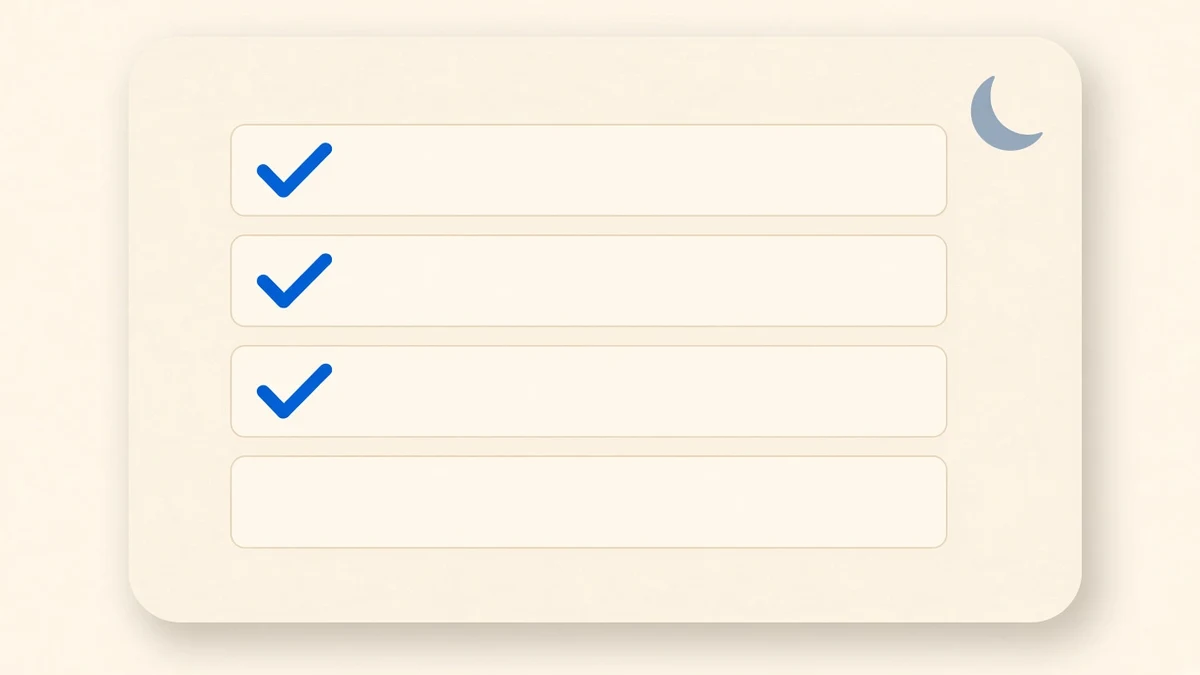
Here is a real-shaped shutdown for someone in product work, at 17:30.
- Capture: two Slack threads need answers tomorrow, one email asks for a document. All three go on the list.
- Small loops: a "yes, Thursday works" reply sent.
- Tomorrow: design review at 11:00. Need to read the spec first.
- First task: "Read the spec, write three questions", starting 9:00, before email.
- Close: laptop shut at 17:44. "Shutdown complete."
Fourteen minutes. The evening is free, and the spec will not ambush anyone.
Making it work at home
Remote work makes the line harder, because the desk is in the house. A few things help:
- Use a physical signal. Close the laptop and put it in a drawer, or put a cloth over the monitor. Out of sight helps.
- Change something. Go for a short walk, change clothes, put on music. A commute did this job for free; now you need a stand-in.
- Turn off work notifications on your phone after the ritual. Most phones can schedule this.
If you keep slipping back to the laptop, our guide to planning your day around a 9 to 5 job covers how to protect the edges of the workday.
When it doesn't work
The ritual will not fix a workload that is too big. If you capture loose ends every evening and the list just keeps growing, the problem is load, not habit. Too many projects at work is about that conversation.
It also can't help if you are on call. Be honest about which evenings are truly off.
Questions about the shutdown ritual
What if something urgent comes in after I shut down?
Decide in advance what counts as urgent enough to reopen the laptop. For most jobs, the honest answer is very little. If you do reopen it, handle the one thing and run a mini shutdown again: capture, next step, close.
Does it work on the days I leave late?
Yes, and those are the days it matters most. On a late day, cut the ritual to two steps: write tomorrow's first task and close the laptop. Five minutes is still better than none.
Should the phrase really be said out loud?
It does not have to be. Some people write "done" in the notebook, some tick a box in their app, some just switch off the lamp. What matters is a fixed, final action that marks the line. The words are just the easiest version.
Shutdown ritual vs end of day routine
People use both terms. An end of day routine for work can be anything: tidying, a walk, a final email check. A shutdown ritual is more specific. Its job is to make sure every open loop has a next step, so your mind can stop tracking them. You can fold the ritual into a longer routine, but keep the capture and first-task steps. They do most of the work.
Signs the ritual is working
After a week or two, most people notice small changes. Evenings feel quieter. Mornings start faster because the first task is already chosen. Fewer things slip, because loose ends get captured at 17:30 instead of remembered at 23:00. If none of that happens, look at which step you are skipping. It is usually the first task for tomorrow, and it is usually the step that matters most.
Start tonight
Use the table above as is for one week. Do not tweak it yet. Write the first task for tomorrow, close the laptop, and say the phrase. If you plan in Todonado, the last step can be dragging tomorrow's first task to the top of the day, so it is the first thing you see in the morning.