Habit Stacking Examples: 30 Stacks for Mornings, Work and Home
Habit stacking links a new habit to one you already do. The formula, 30 habit stacking examples for morning, work and home, and how to build your own.
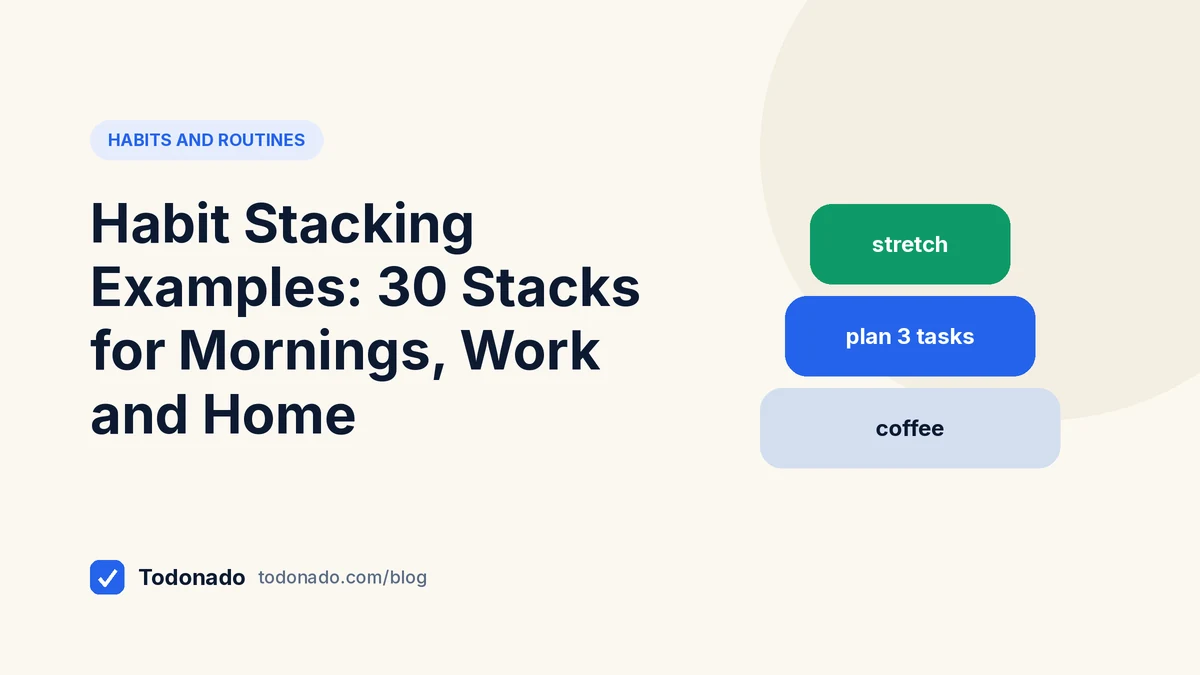
Habit stacking means doing a new habit right after something you already do every day, so the old habit becomes the reminder for the new one. The formula is simple: "After I [current habit], I will [new habit]." For example: after I pour my morning coffee, I will write my three tasks for the day. To start, pick one daily anchor you never skip, attach one small new habit to it, and keep it that way for two weeks before you add another. Thirty examples follow below.
What is habit stacking
The term was made popular by James Clear in his book Atomic Habits. On his habit stacking page, he credits the idea to BJ Fogg, whose Tiny Habits method uses an existing routine as the trigger for a new one. Clear's version of the formula is: "After [CURRENT HABIT], I will [NEW HABIT]."
It works because the hardest part of a new habit is remembering to do it. Your existing habits already happen at the same time, in the same place, every day. Linking a new habit to one of them borrows that reliability. For the basics of starting any habit, see our guide on how to build a habit.
The habit stacking formula
After I [anchor: something I already do daily],
I will [new habit: small, under two minutes to start].
Three rules make it work:
- The anchor must be daily and reliable. Brushing your teeth, yes. Going to the gym, only if you never miss.
- The new habit must be small. One minute, or the first step of something longer.
- The link must be specific. "After I sit down at my desk" beats "in the morning".
30 habit stacking examples
A morning habit stack
| After I... | I will... |
|---|---|
| Turn off my alarm | Drink the glass of water on my bedside table |
| Start the kettle | Do ten squats while it boils |
| Pour my coffee | Write my three tasks for today |
| Brush my teeth | Floss one tooth (and usually keep going) |
| Get dressed | Put my keys, wallet and phone in my bag |
| Sit down to breakfast | Read one page of a book |
| Lock the front door | Say what my first task at work will be |
| Sit on the train | Put my phone away and listen to one podcast |
At work
| After I... | I will... |
|---|---|
| Sit down at my desk | Open my task list before email |
| Close a meeting call | Write the action items in my list |
| Finish a focus block | Stand up and stretch for one minute |
| Eat lunch | Take a ten-minute walk |
| Send the last email of the day | Plan tomorrow's first task |
| Close my laptop | Clear the desk of cups and papers |
| Hang up from a hard call | Take three slow breaths |
Evening
| After I... | I will... |
|---|---|
| Get home | Hang my keys on the hook |
| Finish dinner | Wash my plate straight away |
| Start the dishwasher | Wipe the kitchen counter |
| Put the kids to bed | Lay out tomorrow's clothes |
| Brush my teeth at night | Write one line in my journal |
| Plug in my phone | Leave it in the kitchen, not the bedroom |
| Get into bed | Read for ten minutes |
At home and weekends
| After I... | I will... |
|---|---|
| Make Saturday coffee | Plan the weekend in five minutes |
| Get the post | Open it and sort it straight away |
| Take out the bins | Check the fridge for food that needs using |
| Do a load of washing | Fold one basket while it runs |
| Feed the pet | Water one plant |
| Finish Sunday lunch | Look at next week's calendar |
| Pay a bill | Check one subscription I may not need |
| Come back from a run | Write the distance and time down |
Why the anchor matters more than the habit
Most people choose the new habit first and then look for a time to do it. Habit stacking works better the other way round. Start with the anchor. An anchor is something that already happens every day, at about the same time, in the same place, without any effort from you. That is rare. Most of us have only a handful of moments like that: waking up, the first drink of the day, getting to work, lunch, getting home, dinner and going to bed.
Once you know your anchors, the question becomes: which new habit fits this moment? Some fit naturally. Planning your day fits with your first coffee, because you are sitting still with a few minutes to spare. Tidying the kitchen fits after dinner, because you are already there. A habit that has to travel to a different room or needs a lot of setup is a poor fit, even if the anchor is strong.
How to build your own stack
- List your anchors. Write down 10 things you do every day without fail: wake up, shower, coffee, commute, lunch, get home, dinner, bed.
- Match a habit to a moment. Pick the anchor that sits nearest to where the new habit happens. Flossing goes with brushing. Planning goes with coffee.
- Make it tiny. Start with the smallest version, such as one push-up or one line.
- Track two weeks. Tick each day you did it. After two steady weeks, add a second habit to the stack.
A worked example
Leah wants to stretch daily and journal more. She lists her anchors and finds that she always makes tea after dinner and always charges her phone before bed.
| Week | Stack | Days done |
|---|---|---|
| 1 and 2 | After I put the kettle on after dinner, I will stretch until it boils | 12 of 14 |
| 3 and 4 | Same, plus: after I plug in my phone, I will write one line in my journal | Stretch 13, journal 10 of 14 |
Her first try was "stretch in the evening". It failed, because "evening" is not a moment. The kettle is.
Habit stacking for ADHD
Habit stacking for ADHD can help, because it reduces the need to remember. The anchor reminds you instead. A few tweaks help more:
- Make the cue visible. Put the journal on the pillow, the vitamins next to the kettle.
- Keep stacks short. Two habits on one anchor is plenty.
- Expect missed days. Restart the next day without judging the gap.
Our ADHD to-do list guide has more ways to make tasks visible.
Tracking stacks in Todonado
Todonado does not have a separate habit checklist, but repeating tasks do the job. Add the new habit as a daily repeating task and name it after the stack, such as "After coffee: write 3 tasks", so the anchor is in the name. Give it a small time estimate and it counts toward your day's capacity, which keeps a growing stack honest. If you are trying to stop a habit rather than start one, the quit tracker counts your days. Both are on the Free plan.
Common mistakes with atomic habits stacking
- An unreliable anchor. If you skip the gym twice a week, it cannot carry a new habit.
- A new habit that is too big. "After coffee, I will run 5 km" is not a stack. It is a plan.
- Too many at once. Add one habit at a time and give each two weeks.
- A vague link. "After work" is not one moment. "After I close the laptop" is.
When habit stacking is not enough
Stacking helps you remember. It does not make a habit enjoyable or fix a bad fit. If a habit keeps failing on a good anchor, it may be too big, or the wrong habit for you right now. Shrink it, or swap it. And some habits, like exercise, need a fixed time block rather than a stack, because they take too long to start right after something else.
FAQ
How many habits can I stack? Start with one. Two or three per anchor is the usual limit.
How long until it sticks? It varies a lot by person and habit. Give each one at least two weeks before you judge it.
Can I stack on a habit I want to stop? Yes. "After I open social media, I will close it and take one breath" is a stack too.