The 1-3-5 Rule: How It Works and How to Make It Fit Your Day
The 1-3-5 rule means one big task, three medium and five small each day. How to use it, a template, and how to size the tasks so the nine items fit.
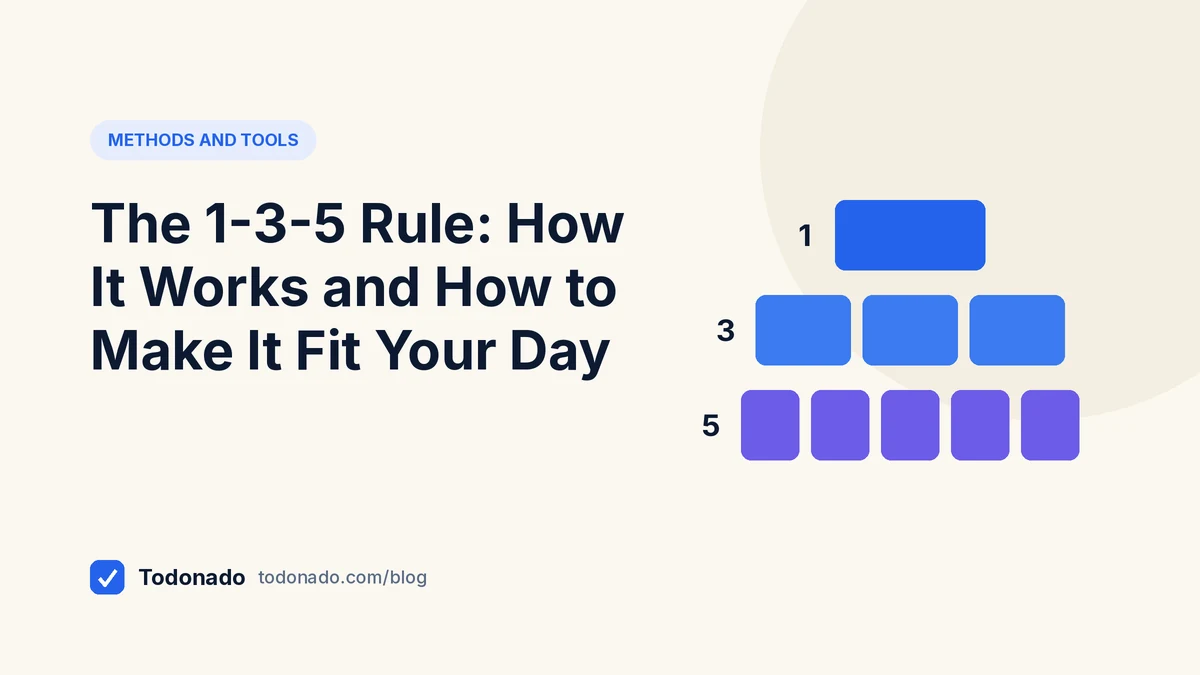
The 1-3-5 rule says you can get one big thing, three medium things and five small things done in a day, so your daily list should hold those nine items and no more. To use it, pick tomorrow's one big task first, then three medium ones, then five small ones, and stop. To make it work in practice, give the sizes real time limits: a big task is about 2 hours, a medium one about 45 minutes, and a small one about 10. Add those up and check that the total fits the hours you actually have.
The rule was popularised by The Muse, which credits its founder Alex Cavoulacos, in an article on a better to-do list. Its main strength is that it puts a ceiling on the list. Its main weakness is that the words big, medium and small mean different things to different people.
How the 1-3-5 rule works
The idea is that a long list hides a simple truth: you cannot do everything on it today. A list with nine slots forces a choice. You decide what matters before the day starts, rather than at 5pm, when you notice half the list is still there.
As a time management tool, the three tiers also give the day a shape.
- The one big thing is the task that would make the day count. A draft, a design, a hard conversation, a key piece of analysis.
- The three medium things are real work but not the main event. A review, a planning call, a report section.
- The five small things are quick jobs. Replies, bookings, a form, a short call.
Small tasks are not filler. Many of them have real consequences when missed, like a renewal or a reply someone is waiting for. Giving them their own slots stops them from crowding out the big task, and stops them from being forgotten.
Put minutes on the sizes
The rule works far better with numbers. Here is a sizing that suits many desk jobs.
| Tier | Count | Typical size | Subtotal |
|---|---|---|---|
| Big | 1 | 90 to 150 min | about 2 h |
| Medium | 3 | 30 to 60 min each | about 2 h 15 min |
| Small | 5 | 5 to 15 min each | about 50 min |
| Total | 9 | about 5 h |
Five hours of task time is a full day for most people, once you take out meetings, messages and breaks. If your day has four hours of meetings, a full 1-3-5 will not fit. Use a 1-2-3 or a 1-1-3 instead. The point is the ceiling, not the exact numbers.
1-3-5 rule examples
A day that fits
Here are two examples from the same job, one on a light day and one on a heavy one.
A marketing manager with one hour of meetings and about five hours of task time:
| Tier | Task | Estimate |
|---|---|---|
| Big | Write the campaign brief | 120 min |
| Medium | Review the agency's draft ads | 45 min |
| Medium | Plan next week's social posts | 45 min |
| Medium | One-to-one with a team member | 30 min |
| Small | Approve two invoices | 10 min |
| Small | Reply to the events team | 10 min |
| Small | Book the meeting room for Thursday | 5 min |
| Small | Send the agenda for Friday | 10 min |
| Small | Update the budget sheet | 15 min |
Total: 290 minutes, under five hours. That fits, with a little room.
A day that does not
The same person on a day with three hours of meetings, so about three hours of task time. They write the same kind of list: a 120-minute big task, three 45-minute medium tasks and five small ones. That is 305 minutes against 180.
The fix is not to try harder. It is to shrink the list: keep the big task, cut to one medium task, and keep three small ones. That comes to about 195 minutes, which is close, and they trim the big task to its first 90 minutes. The 1-3-5 becomes a 1-1-3 for that day.
A 1-3-5 rule template
Copy this into a notebook or a note on your phone the evening before.
DATE: __________     TASK TIME TODAY: ____ hours

1 BIG (about 2 h)
[ ] ______________________________   est: ___

3 MEDIUM (30 to 60 min each)
[ ] ______________________________   est: ___
[ ] ______________________________   est: ___
[ ] ______________________________   est: ___

5 SMALL (5 to 15 min each)
[ ] __________________   [ ] __________________
[ ] __________________   [ ] __________________
[ ] __________________

TOTAL ESTIMATE: ____    FITS?  yes / trim
The two lines at the top and bottom matter most. Writing your task time first, and the total last, turns the template into a check rather than a wish.
The 1-3-5 rule for time management with ADHD
Many people with ADHD like the rule because it is visual and limited. A few changes can help.
- Do one small task first. A quick win can make it easier to start the big one.
- Make the big task's first step clear. "Write the brief" might start with "open last quarter's brief and copy the headings".
- Use 1-2-3 on hard days. Fewer items, same shape.
- Keep the rest out of sight. Everything not in the nine goes on a separate list that you do not look at today.
Our ADHD to-do list guide has more on keeping a daily list short.
How Todonado handles the same idea
Todonado does not use 1-3-5 tiers, but it is built on the same idea: a day has a ceiling. Instead of counting tasks, it adds up their effort estimates in minutes and compares the total with the capacity you set for the day. The capacity meter fills as you add tasks, and the overbooking warning appears before you go over.
That avoids the main weakness of 1-3-5, which is that a "medium" task can quietly be three hours long. You can still use the rule as a way to choose tasks. Then let the minutes tell you whether the nine items actually fit. Free includes the capacity meter and "Plan my day", which fills today from your list without going over.
When the rule does not fit
- Meeting-heavy days. A day with five hours of meetings has room for a 1-1-2 at most.
- Deep work days. Some days need two big tasks and nothing else. That is fine.
- Shift work and care days. If your day is broken into short gaps, small tasks may be all that fits, and that is a real plan too.
For the arithmetic behind all of this, see how to plan a realistic day. If your list is already far beyond nine items, start with how to organize a huge to-do list.
FAQ
Who invented the 1-3-5 rule? It was popularised by The Muse, which credits its founder Alex Cavoulacos. The idea of limiting a daily list is much older.
What if I finish all nine? Stop, or pull the next item from your list. Finishing early is a good sign that your sizing is right.
Can I use the 1-3-5 rule for a week? Some people do one big thing per week plus a daily 1-3-5. That works well for longer projects.