How to Stop Overplanning and Start Doing the Work
How to stop overplanning when plans take longer than the work. Cap planning time, plan only the next step, and use a simple rule for when a plan is good enough.
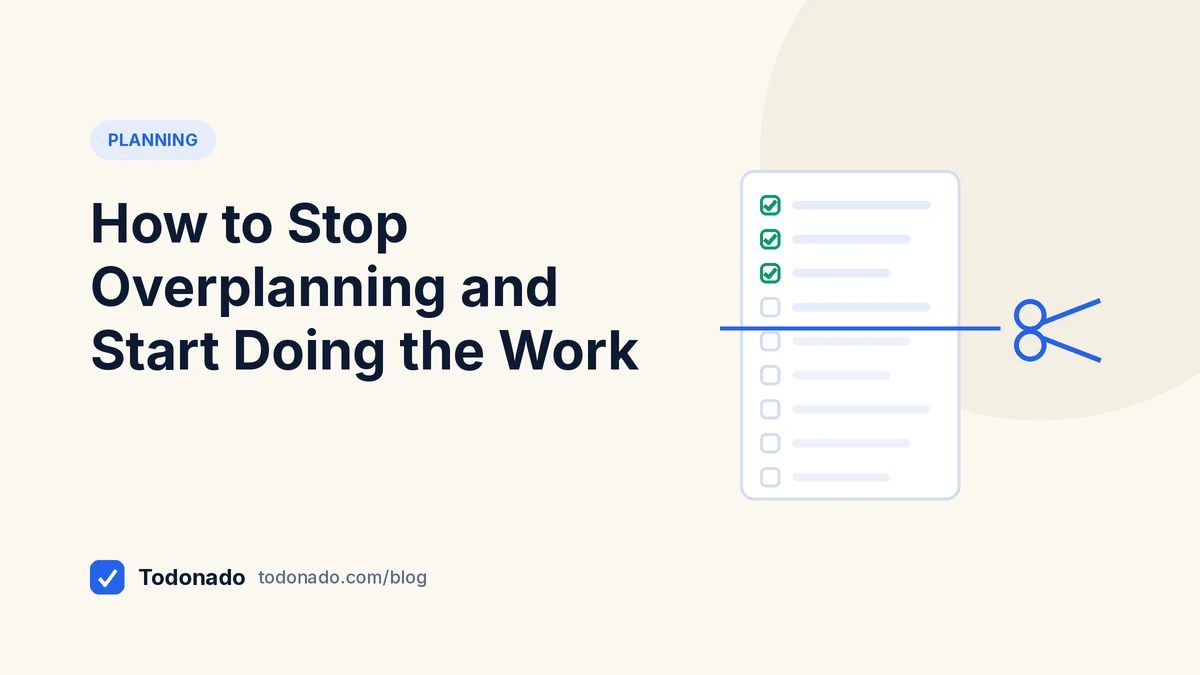
To stop overplanning, give planning a time limit and stop when it runs out. Ten minutes for a day, 30 for a week, and about an hour for a new project is plenty. Plan only as far ahead as you can see clearly, usually the next two or three steps. Then use a simple test: if you know what to do first, roughly how long it takes, and when you will do it, the plan is good enough. Start.
Overplanning is easy to fall into because planning feels productive. You are thinking about the work, organising it, making it look tidy. But a plan is only useful if it leads to the work. When the plan takes longer than the task, or keeps being redone, it has become something else.
Signs you are overplanning
- You rewrite the same to-do list more than once a day.
- You spend longer choosing a planner or app than using one.
- You colour-code, tag and sort tasks you have not started.
- You plan the whole project in detail before doing the first step.
- You feel calmer after planning, but the work is still not started.
- Your day plan has every 15 minutes accounted for, and it breaks by 10am.
One or two of these is normal. If most sound familiar, the planning may be doing a different job: making you feel in control without the risk of starting.
Why overplanning happens
Planning as procrastination
Starting a hard task is uncomfortable. Planning it is not. So the mind picks the comfortable version. This is a common form of procrastination, and it is hard to spot because it looks like work. Our guide on how to stop procrastinating covers the mood side of this.
Overplanning and overthinking
Overplanning and overthinking often travel together. Some people plan in detail because they want to avoid mistakes. If every step is planned, nothing can go wrong. In practice, the plan goes stale as soon as you learn something new, and you plan again.
The plan is the only finished thing
At the end of a hard day, a neat plan is something you completed. That is a real reward. It just is not the reward you need.
A planning-time budget
The simplest fix is a cap. Here are limits that work for most people.
| Plan | Time limit | What it should produce |
|---|---|---|
| Tomorrow | 10 min | 3 to 6 tasks with estimates that fit your hours |
| This week | 30 min | 3 outcomes, fixed points, rough days |
| New project | 60 min | The goal, the first 3 steps, rough milestones |
| A quarter | 2 hours | 3 to 5 goals and what they need first |
Set a timer. When it goes off, stop. If the plan feels incomplete, that is fine. It will be finished by doing.
The good-enough test
A plan is good enough when you can answer yes to four questions:
- Do I know what to do first?
- Do I know roughly how long it takes?
- Do I know when I will do it?
- Will I know when it is done?
That is all. You do not need to know step 9. You do not need colours. You do not need the perfect tool.
A worked example: before and after
Jordan wants to launch a small online course. Here is the plan Jordan made on the first weekend. It took four hours.
BEFORE (4 hours of planning)
- 42 tasks across 8 modules
- every module broken into 5 lessons
- each lesson tagged by type, length and status
- launch date, email schedule, pricing tiers
- 3 colour codes, 2 apps, 1 spreadsheet
Tasks started by Monday: 0
Two weeks later the plan had been redone twice, because the first module took a different shape once Jordan started writing.
Here is the good-enough version, made in 20 minutes.
AFTER (20 minutes)
Goal: a 4-module course live by March
First 3 steps:
1. Outline module 1 in a blank doc (45 min, Tue 9am)
2. Record a 5-minute test video (60 min, Wed 9am)
3. Ask two people if they would pay for it (15 min, Thu)
Milestones (rough): module 1 by end of Jan, all 4 by end of Feb
The second plan has three steps and a few dates. It answers all four questions. By Thursday, Jordan had done all three steps, and learned that the course should be shorter than planned. The first plan would have needed rewriting a third time.
Overplanning your day
Day plans are where overplanning shows up most. A plan that fills every slot from 8am to 6pm has no room for the normal messiness of a day: a call that runs long, a task that takes twice as long, a slow afternoon.
The fix is to plan less. Plan a handful of tasks, give each a rough time, and check the total against the hours you actually have for task work, which is usually far less than your working hours. Then leave the rest of the day loose. Our guide to planning a realistic day has the full method.
If you like time blocking, block only the big tasks and leave gaps. A calendar with every minute blocked does not survive contact with a real day. See time blocking vs time boxing for when each one helps.
How to stop overplanning with a simpler tool
Tools can make overplanning worse, with endless tags, views and settings. Todonado is designed to keep the plan small. You add tasks with a quick effort estimate, set how many hours today has, and the capacity meter shows when the day is full. "Plan my day" fills today from your list without going over, in one tap, so you do not have to arrange the day by hand.
That leaves less to fiddle with. There are projects, sections and priorities if you need them, but you can plan a full day without touching any of them.
How to avoid overplanning in the long run
- Plan at a fixed time. Ten minutes the evening before, or first thing. Not all day.
- Use one tool. Every extra app is another place to reorganise.
- Start before you feel ready. The first step will teach you more than another hour of planning.
- Review what you did, not what you planned. At the end of the week, look at what got done. Our weekly review questions can help.
When detailed planning is right
Not all detailed planning is overplanning. Some work needs it: a wedding, a house move, a product launch with many people, anything with safety risks or legal deadlines. The test is whether the detail helps you act. If it does, keep it. If it only makes the plan look complete, cut it.
FAQ
Is overplanning a form of anxiety? It can be linked to worry for some people. If planning feels compulsive or causes distress, it may be worth talking to a professional.
How long should I spend planning my day? About 10 minutes. If it takes longer, the list is probably too long.
What if I need a detailed plan for work? Write the detail once, then work from the next three steps. Update the plan weekly, not daily.